
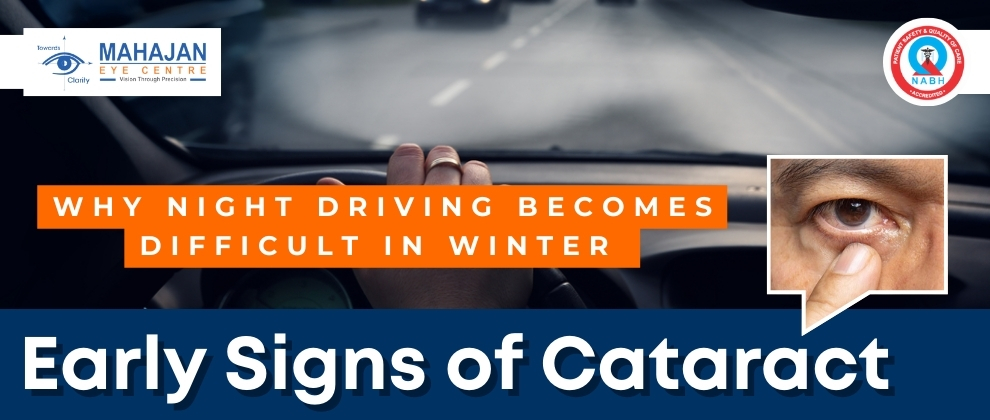
Why Night Driving in Winter Becoming Difficult? It Could Be an Early Sign of Cataract
Winter brings cooler weather, shorter days, and long nights. But for many people, this season also brings a new problem — difficulty in night driving.
At Mahajan Eye Centre, we see an increase in patients complaining of glare, halos, and blurred night vision during winter months.
In many cases, these are early signs of cataract or other age-related eye changes.
Why Night Driving Gets Harder in Winter
1. More Darkness, Less Contrast
Winter days are shorter, meaning more time driving in low light.
Eyes with early cataract struggle to adjust to dark surroundings → vision becomes dim and unclear.
2. Increased Sensitivity to Headlight Glare
Cold air, dryness, and early cataract make your eyes more sensitive to bright lights. This causes:
- Starburst effect
- Halos around lights
- Sudden temporary blindness due to high-beam headlights
3. Pupil Dilates More in the Dark
At night, pupils expand to allow more light in.
But with cataract, this expanded pupil lets in more scattered light, increasing glare and haziness.
4. Fog, Pollution & Winter Smog
Winter smog decreases road visibility.
If your eyes already have early cataract or dryness, smog makes night driving even more stressful.
5. Age-Related Lens Changes
After age 45–50, the natural lens starts to yellow and harden.
Winter lighting conditions worsen these symptoms.
Early Cataract Symptoms You Should Not Ignore
- Difficulty driving at night
- Glare from lights, headlights, or street lamps
- Cloudy or blurred vision
- Need brighter lights for reading
- Faded colors
- Frequent change in eyeglasses
- Trouble seeing in low light
If you have 2–3 of these symptoms, get your eyes evaluated soon.
Why Night Driving Issues Often Indicate Cataract
Cataract blocks and scatters the light entering the eye.
This reduces contrast, clarity, and sharpness — especially in low-light conditions.
That is why night driving is often one of the first things affected, even before daytime vision becomes blurry.
At Mahajan Eye Centre, we use advanced diagnostic systems to detect cataract at the earliest stage.
Should You Get Cataract Surgery for Night Driving Issues?
Yes, if night vision is affecting your safety.
Even early cataract can be removed if it is interfering with your daily life.
Benefits of early cataract surgery:
- Better night vision
- Reduced glare & halos
- Safer driving
- Faster recovery
- More accurate IOL power calculation
- Prevents cataract from becoming hard
At Mahajan Eye Centre, we specialise in MICS (Micro-Incision Cataract Surgery) — a painless, stitch-less procedure with same-day discharge.
Tips for Safer Night Driving This Winter
- Clean your glasses regularly
- Use anti-glare lenses
- Avoid looking directly at bright headlights
- Drive slower in fog or low visibility
- Use proper windshield cleaning
- Get your eyes checked once a year
- Use lubricating drops to avoid dryness
Mahajan Eye Centre – Your Trusted Cataract Specialist
We provide:
- Advanced MICS cataract surgery
- Monofocal, multifocal &toric lenses
- 100% sterile & safe OT
- Latest diagnostic tools
- Experienced cataract surgeons
Your vision and safety always come first.
Book Your Winter Vision Check-Up Today
If night driving feels uncomfortable or unsafe this season, get a cataract evaluation immediately.


